

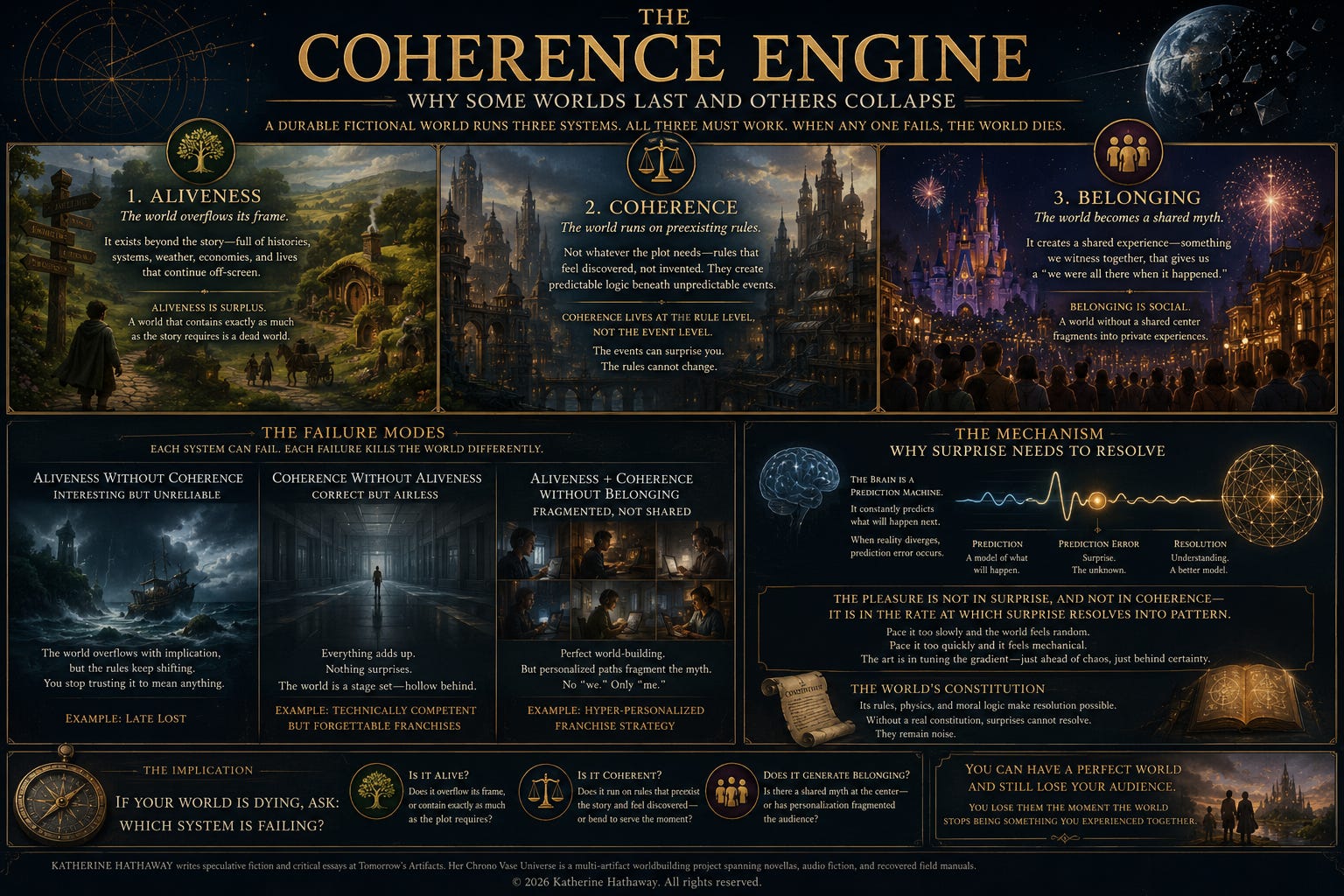
There is a question that haunts every world-builder, every game designer, every showrunner sitting across from a studio executive trying to explain why their franchise is bleeding audience.
Why do some imagined worlds become permanent fixtures in the human mind — places people return to for decades, that they grieve when they end, that they name their children after — while others, equally expensive, equally polished, collapse after one season and are forgotten before the next year’s upfronts?
The standard answers are unsatisfying. Good writing. Strong characters. Production value. These are real, but they’re descriptions of quality, not mechanisms. They tell you what a successful world *has*, not *why it holds*.
I want to propose a different frame. I’m calling it the Coherence Engine.
## The Three Things a World Needs to Survive
After years of thinking about this — as a speculative fiction author, as a design student, and frankly as someone who has watched a lot of beloved franchises destroy themselves in real time — I’ve come to believe that every durable fictional world is running three systems simultaneously. Not one. Not two. All three. And when any one of them fails, the world dies, even if the other two are working perfectly.
**The first system is Aliveness.**
A world feels alive when it seems to exist beyond the frame — when you believe there are things happening off-screen that you haven’t been told yet. When the characters have histories that predate the story. When the world has weather, economics, factions, and grudges that don’t exist to serve the plot but simply *are*.
Aliveness is what makes readers write fan fiction. It’s the sense of a world overspilling its container. Middle-earth feels alive because Tolkien’s languages were complete before the stories began. The *Alien* franchise feels alive because the xenomorph clearly belongs to a biology larger than any individual film. The Shire feels alive because its calendar systems, its pipe-weed varieties, its postal history — none of it is *necessary*, and all of it is there.
Aliveness is the condition of *surplus*. A world that contains exactly as much as the story requires is a dead world.
**The second system is Coherence.**
Aliveness without coherence is chaos. The world can overflow its frame all it wants — if the overflow contradicts itself, the reader’s brain rejects it.
Coherence is not consistency for its own sake. It is something more specific: it is the sense that the world runs on *rules that preexist the story and will outlast it*. Not rules the author invented to make the plot work, but rules that feel discovered rather than constructed. Gravity. Consequence. The way power corrupts in this particular world. The way grief behaves here. The way magic costs something.
Here is the key distinction: **coherence lives at the rule level, not the event level.** The events can surprise you endlessly. The rules cannot change. Conway’s Game of Life has four rules and produces infinite unrepeating patterns, none of which were scripted, all of which obey the same physics. That is a coherent generative system. Chess is coherent. Language is coherent. The best fictional worlds are coherent in exactly this way — you don’t know what will happen next, but you trust that whatever happens will be intelligible in terms of the world’s own logic.
When a world loses coherence, audiences don’t say “that was inconsistent.” They say “that felt wrong.” They say “that wasn’t the show I loved.” They say “they broke it.” The specific failure is usually invisible; the feeling of violation is not.
**The third system is Belonging.**
This is the one that almost nobody talks about, and I think it is the most important one.
Aliveness is a private experience. Coherence is an intellectual one. Belonging is *social*. It is the condition in which a world becomes a *shared myth* — something you experienced alongside other people, at the same time, in the same way, and that therefore gives you something to witness together.
Belonging is why the MCU’s Phase 1 and 2 were a cultural event and Phase 4 collapsed into noise. It’s why the water-cooler conversation about *Game of Thrones* season one was electric and the conversation about season eight was grief. It’s why standing in Disneyland alongside strangers who are feeling the same thing you are feeling produces something a private experience cannot.
Belonging requires that the world remain *general enough to be shared*. A story bent perfectly to one reader’s private psychology may be maximally resonant for that reader — but it cannot be held in common. The more personalized an experience becomes, the more it fragments. Belonging is destroyed by excessive personalization, even when that personalization is technically superior.
Disney understood this for sixty years before they forgot it. The original theme parks were designed around *shared spectacle* — experiences that ten thousand different people could have simultaneously and feel, together, that they were inside the same story. That is a designed condition, not an accident. It is designed belonging.
---
## The Failure Modes
Each system has a characteristic way of failing, and each failure kills the world differently.
**Aliveness without Coherence** produces the feeling of a world that is *interesting but unreliable*. You are intrigued by the surplus. You sense the depth. But the rules keep shifting, and eventually you stop trusting the world to mean anything. Early *Lost* was all aliveness — the island overflowed with implication, with mystery, with the sense of vast systems operating beneath the surface. Late *Lost* revealed that there were no systems. There was only improvisation dressed as profundity. The world died when its aliveness was exposed as decoration.
**Coherence without Aliveness** produces the feeling of a world that is *correct but airless*. Everything adds up. Nothing surprises. The rules are internally consistent and completely visible, which means there is no depth to fall into. Many technically competent franchises die this way — they are well-engineered and utterly forgettable. The world feels like a stage set: perfectly rendered from the front, hollow behind.
**Aliveness and Coherence without Belonging** produces the failure mode that I think is going to define the next decade of entertainment: *world-building that fragments instead of coheres*. A world can be alive and internally consistent and still destroy its own myth by individualizing too aggressively — by giving each audience member a personalized path through it, each reader a private resonance that is just theirs. The world becomes a collection of separate private experiences with no shared center. There is no “we were all there when it happened.” There is only “I had this version” and “I had that version” and nothing to hold in common.
This is the structural failure of contemporary franchise strategy, and it is not an accident. It is the predictable outcome of optimizing for individual engagement rather than collective myth.
---
## The Mechanism: Why Surprise Needs to Resolve
There is a reason this framework is not merely intuitive — it maps onto what cognitive science tells us about why fiction works at all.
Predictive processing theory, developed across decades of neuroscience research, proposes that the brain is fundamentally a prediction machine. It is constantly generating models of what will happen next and updating those models when reality diverges from prediction. The experience of understanding — of something *making sense* — is the experience of prediction error resolving. Confusion is unresolved prediction error. Meaning is the resolution of it.
This is why the pleasure of a good story is not the pleasure of surprise alone, and not the pleasure of confirmation alone. It is the pleasure of *surprise that resolves* — of prediction error that converts into a better model. The twist that recontextualizes everything you thought you knew. The ending that was inevitable in retrospect. The character revelation that makes their earlier behavior suddenly legible.
What this means for world-building is precise: **the pleasure is not in the surprise, and not in the coherence — it is in the rate at which surprise resolves into pattern.** That rate is a designable variable. Pace it too slowly and the world feels random. Pace it too quickly and it feels mechanical. The art is in tuning the gradient — keeping the audience just ahead of chaos, just behind certainty, in the productive zone where understanding feels earned.
The authored constitution of a world — its rules, its physics, its moral logic — is what makes that resolution possible. Without a real constitution, surprises cannot resolve into anything. They remain noise. This is why the feeling of a broken world is so visceral: it is not an aesthetic disappointment. It is the cognitive experience of prediction error with no resolution path. The world has stopped making sense in the literal neurological meaning of that phrase.
---
## What Disney Built, and What It Lost
Walt Disney’s original insight was not about animation or storytelling or even technology. It was about *the three systems operating together*.
The early parks were alive — they overflowed with detail, with history, with the sense that Main Street had been there long before you arrived and would continue after you left. They were coherent — the logic of each land held, the physics of each world was consistent, the rules were discoverable. And they generated belonging at industrial scale — they put ten thousand people inside the same story simultaneously, and the shared experience of that was the product.
The decline of the modern Disney estate — the parks, the franchises, the streaming — can be mapped almost exactly onto the degradation of belonging while aliveness and coherence were maintained or even improved. The content is technically excellent. The worlds are internally consistent. But the strategy has prioritized segmentation over shared myth, personalization over collective experience, individual IP extension over the maintenance of the central cultural fire.
You can have a perfect world and still lose your audience. You lose them the moment the world stops being something you experienced *together*.
---
## The Implication
The Coherence Engine is a diagnostic, not a recipe. It does not tell you how to build a world. It tells you what your world needs to *remain* one.
If your world is dying and you cannot figure out why, the question to ask is not “is the writing good?” The question is: which system is failing?
Is it alive? Does it overflow its frame, or does it contain exactly as much as the plot requires?
Is it coherent? Does it run on rules that preexist the story and feel discovered rather than invented? Or do the rules bend to serve the moment?
Does it generate belonging? Is there a shared myth at the center — something that can be witnessed together — or has personalization fragmented the audience into private experiences with no common ground?
Most world-building advice addresses the first two. Almost none of it addresses the third.
That gap is, I think, the frontier.
---
*Katherine Hathaway writes speculative fiction and critical essays at Tomorrow’s Artifacts. Her Chrono Vase Universe is a multi-artifact worldbuilding project spanning novellas, audio fiction, and recovered field manuals. This essay introduces the Coherence Engine framework, which she is developing as a design and analytical tool for narrative world-building.*
*© 2026 Katherine Hathaway. All rights reserved.*